
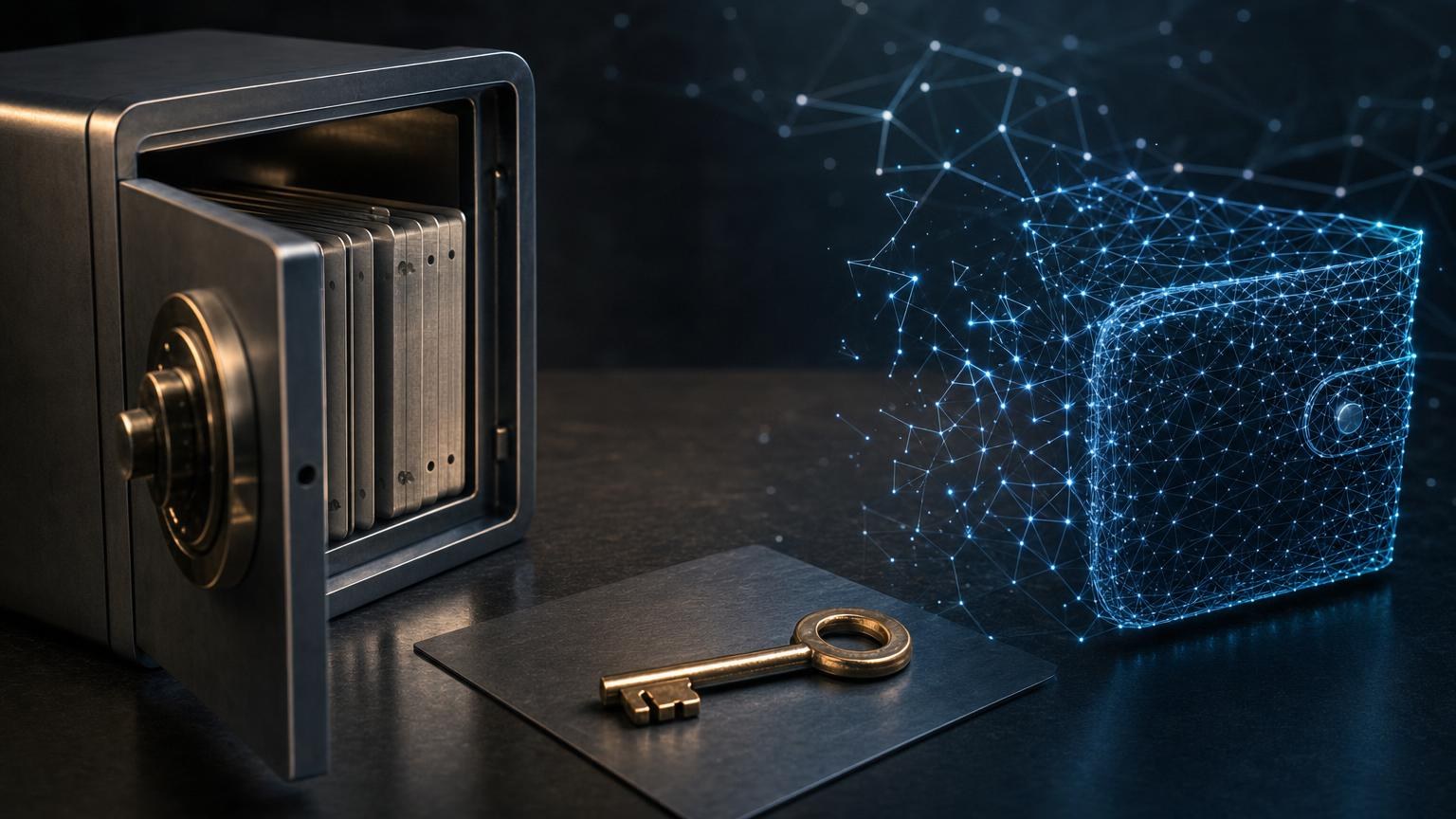
A private key authorizes transactions from a specific blockchain account, while a seed phrase usually serves as a human-readable backup from which a deterministic wallet can derive many keys and addresses. Both are high-value secrets: exposing either one may give another person control over the associated assets. Safe storage therefore requires two protections at once—preventing unauthorized access and preserving a reliable path to recovery.
How to Evaluate Seed Phrase and Private Key Claims
The table uses a claim-verification protocol rather than treating short security slogans as universal rules. Each claim begins with the technically correct formulation, followed by a verdict, the source of the oversimplification, the potential harm, a verification method, and an actionable conclusion.
| Correct statement | Verdict | Why the oversimplification arises | Potential harm | How to verify it | Practical conclusion |
|---|---|---|---|---|---|
| A seed phrase and a private key are related but not interchangeable concepts. A BIP39 mnemonic is converted into a binary seed, which can then be used by a deterministic wallet to generate keys. A wallet imported from one standalone private key may have no corresponding mnemonic at all. [1] | Confirmed | Wallet interfaces may display either secret as an “export” or “backup,” encouraging the assumption that both represent the same object in different formats. | Backing up only one visible private key may fail to preserve other accounts, change addresses, tokens, or addresses created later. Conversely, exposing a seed phrase may compromise far more than one address. | Consult the wallet’s official documentation and identify its backup standard, derivation method, and supported recovery paths. A BIP39-compatible phrase should pass the standard’s checksum rules, but it must never be entered into an untrusted online checker. | Back up the wallet using the recovery method specified by its developer. Do not assume that exporting one private key is equivalent to backing up the complete wallet. |
| Possession of a usable seed phrase or private key can be sufficient to authorize transactions without the original phone, computer, hardware wallet, PIN, or biometric lock. A private key controls signing authority, and a wallet backup can reproduce the keys on another compatible device. [2] | Confirmed | A PIN or fingerprint visibly protects the everyday wallet interface, so it can be mistaken for protection that follows the seed phrase wherever it is restored. | A person who obtains the backup may recreate the wallet elsewhere. Changing the PIN, deleting the app, or remotely wiping the original phone does not invalidate an already exposed recovery secret. | Read the wallet’s official recovery instructions. They should explain whether the backup can restore access on a replacement device and whether any additional passphrase is required. | Treat an exposed seed phrase or private key as compromised. Create a new wallet with a newly generated backup in a trusted environment and move the assets after verifying the destination address and network. |
| A hardware wallet reduces online key exposure, but it does not make the recovery backup unnecessary. If the device is lost, damaged, reset, or becomes unusable, the supported backup is normally the recovery path. [3] | Confirmed | The device is the visible tool used to approve transactions, which can make it appear to be the only place where access exists. | Keeping the device without a verified backup creates a single point of failure. Storing the device and backup together can also allow one theft, fire, or other event to affect both. | Check the manufacturer’s official recovery procedure and confirm the precise backup format before funding the wallet. Use only the device’s built-in backup verification function or another method explicitly documented by the manufacturer. | Protect the device and its backup as separate security layers. Keep them in different controlled locations when the physical threat model justifies it. |
| An offline physical backup generally avoids several remote-theft risks, while a digital copy adds exposure to malware, account compromise, synchronization, and unnoticed duplication. Encryption can reduce some digital-storage risks but does not automatically make an online backup equivalent to an offline one. Official wallet guidance commonly warns against screenshots, photographs, email, and cloud storage. [4] | Depends on conditions | Encrypted cloud storage is convenient and familiar, and the encryption label may be interpreted as protection against every failure mode. | A screenshot can be copied into cloud backups, thumbnails, temporary folders, device migrations, or compromised accounts. The owner may never see evidence that the secret was duplicated. | Inspect where the device stores photographs, notes, clipboard contents, backups, and synchronized files. Review whether any recovery phrase has ever touched an internet-connected keyboard, camera, browser, messaging service, or general-purpose computer. | Generate and record the backup through the wallet’s documented procedure without photographing, scanning, emailing, or typing it into ordinary software. If a digital copy already existed, deleting it cannot prove that no copy remains; consider migration to a new wallet. |
| A backup’s material must match the expected physical hazards, but no material is universally safest. Paper can be adequate in a controlled environment, while more durable media may offer better resistance to water, heat, abrasion, or long storage periods. Physical durability does not protect against theft or incorrect transcription. | Depends on conditions | Marketing often reduces storage design to a single material property, such as fire resistance, while ignoring privacy, access control, legibility, and recovery accuracy. | A durable plate stored in an obvious place can be stolen. A concealed backup can become inaccessible to its owner or heirs. Poorly stamped letters, ambiguous abbreviations, corrosion, or loss of word order can make a physically intact backup unusable. | Compare the medium against a written threat model: fire, flooding, humidity, unauthorized access, relocation, accidental disposal, and long-term readability. Confirm that every word and its order can be read without exposing the phrase to a camera or online tool. | Choose the medium and location together. Durability is only one requirement; secrecy, accurate transcription, controlled access, and recoverability matter as well. |
| Manually dividing one seed phrase into word groups is not the same as using a documented threshold-backup scheme. A formal multi-share method defines how many shares exist, how many are required, and how reconstruction works. In a threshold arrangement, losing too many shares makes recovery impossible. [5] | Misleading | Writing the first half in one place and the second half elsewhere appears to remove the danger of one complete copy without introducing new technology. | Improvised splitting can create fragile recovery dependencies, reveal useful portions of the secret, confuse word order, or leave the wallet permanently inaccessible after one fragment is lost. | Check whether the wallet explicitly supports a named multi-share standard and provides an official recovery workflow. A set of manually divided words should not be described as a cryptographic threshold backup. | Use a conventional single backup or a wallet-supported multi-share system. Do not invent a splitting method unless its security and recovery properties have been independently specified and understood. |
| A BIP39 passphrase creates a different derived wallet; it is not merely a password that can be reset. Under BIP39, every passphrase produces a seed, while only the exact intended passphrase opens the intended wallet. [1] | Confirmed | Wallet software may call it an “extra word” or “passphrase,” terms associated with ordinary account passwords and recovery emails. | A forgotten character, capitalization difference, space, or alternate spelling can lead to a valid but empty wallet. If the passphrase is stored with the seed phrase, much of the additional separation is lost. | Read the wallet’s official passphrase documentation and perform a documented recovery check before relying on the arrangement. Confirm that the restored addresses match independently recorded public addresses; never validate a passphrase by entering it on a website. | Use a passphrase only with a clear backup and recovery plan. Preserve it separately from the seed phrase and account for exact spelling, case, spacing, inheritance, and the possibility of memory loss. |
| Support staff, exchanges, wallet developers, and legitimate counterparties do not need a self-custody seed phrase or private key to receive a payment, investigate a transaction, or provide an address. Wallet vendors explicitly warn that recovery backups are targeted by impersonation and phishing. [3] | Confirmed | Phishing prompts imitate familiar identity checks, wallet synchronization notices, token claims, security alerts, or technical-support procedures. | Entering the secret into a form or sending it in a message can transfer effective control of the wallet to an attacker. A convincing interface does not limit what the recipient can do with the recovered keys. | Close the message or site and independently open the wallet provider’s official application or documentation. Check whether the requested task can be completed with a public address, transaction hash, or signed message instead of a secret. | Never disclose a seed phrase or private key in chat, email, a browser form, a support ticket, or a remote-access session. Treat any unsolicited request for one as an incident rather than a verification step. |
Where the Honest Answer Depends on Context
Custodial and self-custody accounts are different
A centralized account may use login credentials, identity checks, and an operator-controlled recovery process rather than giving the customer a seed phrase. A self-custody wallet places recovery responsibility on whoever controls its keys and backup. Advice written for one model cannot automatically be applied to the other.
Before withdrawing cryptocurrency, identify who will control the destination keys. If no seed phrase is shown, that alone does not prove a problem: the wallet may use another backup standard, a standalone key, multiparty computation, a smart-contract account, or custodial control. The correct recovery procedure must come from the specific wallet’s documentation.
The appropriate number of backup locations is threat-dependent
One copy minimizes the number of places an attacker can search but creates a greater risk of total loss. Multiple complete copies improve redundancy while increasing the number of exposure points. Threshold shares can balance these concerns, but they add operational complexity and compatibility requirements. There is no universal location count that solves every household, business, inheritance, or travel scenario.
Recovery testing can improve reliability or expose the secret
A controlled recovery check can detect transcription errors and confirm compatibility. An unsafe test—especially one involving a website, an unknown app, screen sharing, a camera, or a networked computer—can disclose the backup. The safest available procedure depends on the wallet model. Follow the manufacturer’s documented on-device verification or recovery method, and verify restored public addresses before assuming the process succeeded.
A suspected leak requires a different response from a lost device
If only the device is missing and the backup remains private, the PIN and device design may provide time to recover. If the seed phrase or private key may have been copied, the secret itself can no longer be trusted. The practical response is to establish a new wallet from fresh entropy and transfer the assets, rather than merely changing an app password or buying another device.
Storage Checklist for Risks Outside the Core Claims
- Control the setup environment: create and record the backup away from cameras, microphones, visitors, screen-sharing software, and unnecessary connected devices.
- Preserve exact order: record every word clearly and retain its position. Do not rely on handwriting that another authorized person could misread years later.
- Record non-secret identifiers separately: preserve a small set of public receiving addresses, wallet type, backup standard, and relevant derivation information where the wallet requires it. These details can help verify a restoration without exposing spending authority.
- Plan for incapacity: an inheritance or emergency process should explain how an authorized person can locate and use the backup without placing the complete secret in an ordinary will, email, or shared document.
- Review access after life changes: relocation, separation, a damaged safe, changes in trusted persons, or renovations can invalidate an otherwise reasonable storage plan.
- Do not destroy the previous backup prematurely: after migrating to a new wallet, first confirm receipt at the new addresses and verify that no required assets remain under the old keys. Blockchain transfers can be irreversible, and an incorrect address or network may result in loss.
Practical Next Step Before Moving Assets
Once the wallet and recovery plan are ready, verify the exact asset, destination address, blockchain network, and any required memo or tag before creating a transfer. A small preliminary transaction can help detect an address or network mismatch, although it cannot make a later transaction reversible or eliminate every risk.
For an exchange operation, check the currently supported asset, network, direction, and compliance requirements before submitting a request. Availability can vary, and verification conditions may depend on the transaction route and compliance results. Review the current exchange conditions rather than assuming that every pair or network is available.
The final security test is straightforward: an unauthorized person should not be able to discover enough information to spend the assets, while an authorized person should still be able to recover the correct wallet after device loss, physical damage, or a long period without access. Any storage design that satisfies only one side of that test remains incomplete.